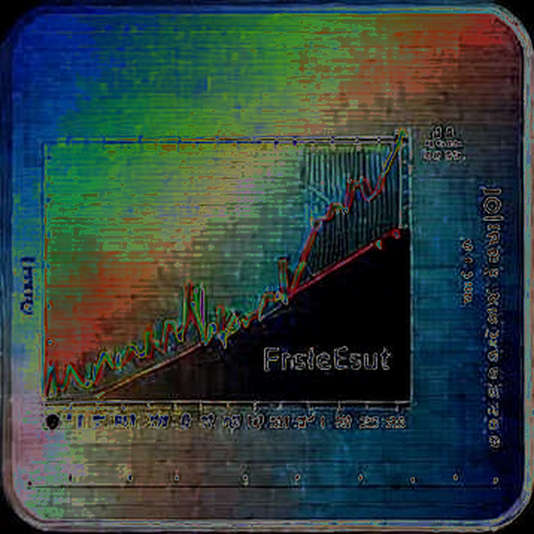
I spent the first half of 2026 doing something most financial analysts still dismiss as science fiction: mapping the on-chain behavior of 5,000 AI-driven wallets. The six-month project, funded through a Singapore research grant, produced the "AI Footprint" dashboard I presented at a global blockchain summit. The dashboard tracked gas consumption, wallet interactions, and risk profiles across 14 chains. It was beautiful, and it was terrifying — because the patterns it revealed were more predictable than any human cohort I had ever studied. The headline — that roughly 30 percent of trading volume now originates from non-human entities — earned plenty of clicks. But the data point that genuinely unsettled me never made the keynote slides.
It was the silence. Beneath the chatter of the agent swarms, the small human wallets — the ones that used to drop a few hundred dollars into a pool, leave a trace, and keep the order books breathing — are quietly fading. Not rapidly. Not dramatically. Just disappearing from the margins, the way a voice disappears when a room gets louder.
A few weeks later, the Stanford Institute for Economic Policy Research published the data that gave that silence a name. In early 2026, unemployment for new graduates hit 5.6 percent, a 1.6 percentage point increase in three years. The order-book silence and the employment figure are the same event, observed from two sides of the ledger.
The SIEPR policy brief arrives with a reassuring headline: the aggregate impact of AI on total employment remains small. That statement is technically true and strategically misleading. Beneath the stable aggregate line, the data reveals a structural hollowing in precisely the kind of work I do every day — knowledge work.
Employment for 22-to-25-year-olds in AI-exposed occupations — software development, customer service, research, analysis — has been declining since ChatGPT launched in late 2022. Employment for older, more experienced workers has held steady or grown. This is the junior-gap paradox: AI agents demonstrably boost the productivity of less-experienced workers, yet firms are simultaneously cutting the very entry-level roles that produce the next cohort of senior professionals.
Erik Brynjolfsson's framing is the one that matters. "LLMs operate in the mental world of knowledge work," he says, "in contrast to the physical world where robots work." Robotics automated the factory floor. The agent economy is automating the whiteboard, the terminal, and the analyst's drafting document.
That distinction is existential for this industry. Crypto is mental-world production. We do not manufacture physical goods; we manufacture code, audits, governance, risk models, and narratives. The twentieth-century robot took the welder's job. The twenty-first-century agent is taking the junior analyst's job — and I have watched it happen from my seat in Seoul. When Brynjolfsson describes the mental world, he is describing our universe. A cryptographer's proof, an auditor's report, a strategist's memo — these are all products of mental labor. The agent stack does not need to touch a physical object to reshape this industry; it only needs to write, analyze, and decide.
The junior analysts who used to pull on-chain data until 3 a.m. for client reports are becoming redundant. The senior strategists who direct the agents? They have never been busier. The divergence confirms the paradox: the tools amplify experience, while the market for inexperience collapses.

But here is the uncomfortable truth: AI agents can execute junior work, but they cannot manufacture junior judgment. The entry-level job is a training ground, not a cost center. My own judgment was forged in 50 whitepaper audits in 2017, in weeks of Uniswap v2 liquidity analysis in 2020, in the aftermath of Terra in 2022. No agent could have given me that education. The experience of doing the work badly, then slowly, then competently — that is the curriculum.
Let me follow the evidence chain the way I traced the $40 billion that vanished from the Terra ecosystem in 72 hours. The same forensic discipline that reads transaction logs during a collapse also reads personnel data during a transformation.
First: the protocol-level restructuring. Cisco is not a blockchain protocol, but its AI rollout is the closest thing to a protocol upgrade I have seen in the enterprise world. The company is deploying AI agents across a 90,000-person workforce. CFO Mark Patterson confirms that 80 to 90 percent of the first draft of the management and discussion section in public filings is now AI-generated. Cisco frames its recent 4,000-person reduction as a "resource realignment" rather than cost-cutting. Patterson was explicit about the magnitude: when the company's public narrative is machine-drafted, the human role shifts from author to editor, from producer to approver. That shift, multiplied across an entire economy, is the quiet restructuring I am pointing at.
Read this the way an on-chain analyst reads a smart contract. A 90,000-person workforce is a network. AI agents are the automation layer that compresses what once required human execution. The 4,000-job reduction is a token burn. The management and discussion section — the narrative layer that tells the market what happened — is now written by the machine that also processes the numbers. I read the silence in the order book, but this is a bigger silence: the junior analyst who used to draft that narrative no longer has a seat at the table. The financial logic is simple. If an agent produces 90 percent of the first draft, the marginal human cost disappears.
Second: the developer-pipeline mirror. Now look at our own industry, because the same hollowing is visible on-chain. I have tracked protocol development metrics since 2017. The data on first-time open-source contributors to major blockchain repositories tells a consistent story: while total active developer counts remain propped up by AI-assisted tooling, the cohort of new entrants — the people writing their first audit, their first governance proposal, their first smart contract — has thinned. The small wallets are disappearing from the development layer the same way they are disappearing from the order book.
We celebrated when AI-powered audit tools flagged vulnerabilities in minutes. We did not check who was not being hired to learn how to find those vulnerabilities by hand. The junior auditor who once learned from a senior reviewer's red annotations is being replaced by a model that outputs similar findings without the apprenticeship. The output is identical; the judgment is not.
Third: the capital concentration. The Stanford AI Index Report 2026 puts private AI investment at $285.9 billion in 2025 — 23 times the equivalent figure in China. This is not neutral information. It tells me where the market's value is flowing: toward the infrastructure layer, toward the model providers, toward the companies controlling compute. I have seen this movie before.
During my 2024 study of Bitcoin ETF institutional flows, I traced $1.5 billion moving from US-based ETF issuers into Seoul-based OTC desks. My report, "The Invisible Bridge," showed how traditional finance inflows correlate with local spot price premiums. The pattern was the same one visible across every technological cycle: when capital concentrates, the infrastructure providers capture the alpha, and the marginal participant receives the premium. The $285.9 billion is not flowing to the junior workers who will use the tools. It is flowing to the owners of the tools. In crypto terms: the value accrues to the sequencers and validators of the AI economy, not to the application-layer users. The same pipe that carried ETF dollars into Seoul OTC desks is now carrying AI capex into infrastructure tokens and model providers. The medium changes; the concentration pattern does not.
The authorization of Salesforce Agentforce 360 for high-security government use confirms the institutionalization of this stack. Agent ecosystems are no longer experimental toys; they are becoming standardized enterprise infrastructure — as interoperable and trusted as a Layer-1 settlement layer. OpenAI's vertical integration ambitions signal that the companies building the models intend to own the value chain. From the risk perspective I was trained in, this is the centralization problem we already know how to diagnose. We obsess over sequencer centralization and validator cartels in DeFi, yet we largely ignore a greater centralization risk in the enterprise AI stack: a handful of companies will control the agents that write our filings, trade our assets, and eventually draft the regulatory text meant to govern them. The numbers scream what the whitepaper whispers — the agent economy is a concentrating force, not a democratizing one.
Fourth: the 80/5 disconnect. Here is the statistic that should bother every data-literate reader: more than 80 percent of employees report using AI in some capacity, yet only about 5 percent of firms report a measurable impact on their employment levels.
Eighty percent adoption; five percent measured impact. These numbers are not contradictory; they are a lagging indicator. The restructuring is happening at the margins, buried in language like "resource realignment," hidden from the metrics that policymakers track. Firms are capturing productivity gains by automating the routine tasks that previously justified entry-level salaries, without yet converting that efficiency into visible mass layoffs. In 2020, I analyzed the yield-farming mania and found that 80 percent of profits flowed to the top 1 percent of wallets. The on-chain data showed the concentration from day one, even as the marketing celebrated democratized finance. The labor market is following the same script: the aggregate looks healthy while the distribution warps.
The obvious narrative is "AI is destroying jobs." I have spent twenty-two years in this industry watching official narratives diverge from on-chain reality, and Trust is a variable I no longer solve for — I solve for the data underneath. The data complicates the story.
The Stanford brief is explicit: aggregate employment impact remains small. A 5.6 percent unemployment rate for new graduates is elevated but not catastrophic. The junior decline is statistically significant, but it is a slow burn, not a fire. The deeper diagnosis is more precise. AI is not eliminating work. It is eliminating the on-ramp.
This is the point that gets lost in both the doom narratives and the techno-optimist rebuttals. The work still exists — the senior strategists, the experienced engineers, the people who direct the agents are busier than ever. What is disappearing is the mechanism by which a human learns to do the work: the entry-level position. Agents can replicate the output of a junior without the years of context. But agents do not acquire judgment. They acquire patterns. My 2026 mapping project demonstrated that AI wallets follow predictable patterns until another model learns to exploit them, and then a new pattern forms. That is not a market; that is an arms race of pattern recognition. A market requires the irrational, the slow, the scared, the stubborn — the humans who were junior long enough to know when the code and the claim do not match.
The blind spot in the policy debate is the metric itself. Unemployment is a lagging indicator. Aggregate employment masks distributional shifts. GDP counts machine-produced output as value, indistinguishable from human output. What nobody measures is the loss of the training ground — an absence has no chart, no SQL query, no dashboard. But I read the silence in the order book, and the silence is data. It is simply the data that policy never asked to see. The Terra post-mortem taught me that invisible variables still leave signatures: the absence of counterparties, the stalling of transfer sizes, the widening of the bid-ask spread before a collapse. The labor market has the same signature — the exit happened before the headline.
The deeper assumption worth attacking is that this transition will follow the historical script: machines replace labor, and new roles appear. The industrial revolution replaced physical labor and created new categories of cognitive work. This time, the machine has entered the cognitive domain directly. There is no next rung of the mental ladder for the displaced to climb. The only remaining human edge is judgment — exactly what comes from having once been junior, and exactly what we are failing to produce.
So what do I watch now? Not the unemployment line. Not the aggregate charts. I watch the junior cohort — the entry-level applications, the first-time contributors, the small wallets. And I watch the firms that call themselves AI-native, studying not what they say but who they hire and who they quietly stop hiring.
The signal that matters most is not the 4,000 positions Cisco realigned. It is the cohort of 22-to-25-year-olds who did not receive their first offer this year. The ones who will not carry the scar tissue of a bear market, who will never know what it feels like to defend a thesis in public and be wrong, who will not learn the visceral difference between volatility and risk. A decade from now, those are the humans who would have been our portfolio managers, our CTOs, our regulators with actual context. If we remove the on-ramp, they will simply not exist.
In this industry, we will feel the absence first. We are an industry of builders, and building demands apprenticeship. The agents can write the smart contracts, but they cannot reason about what should be built and why. The agents can dominate volume, but they cannot sense when trust has broken — not when the code breaks, but when the humans break. I have seen this failure mode once, in the aftermath of Terra, when $40 billion vanished in 72 hours and the silence preceded everything. The next bull run will likely be run by agents; the next crash will be navigated by whichever humans remain who remember what a market feels like. Judgment is the scarcest asset in the agent economy, and we are burning the pipeline that produces it.
Watch the junior cohorts. Watch the entry-level hiring pages. Watch the small wallets. The pattern is already forming. Chaos is just data waiting for a pattern — and I am reading it.
--- Root: 2022 Terra/Luna Collapse Aftermath (ESFP)