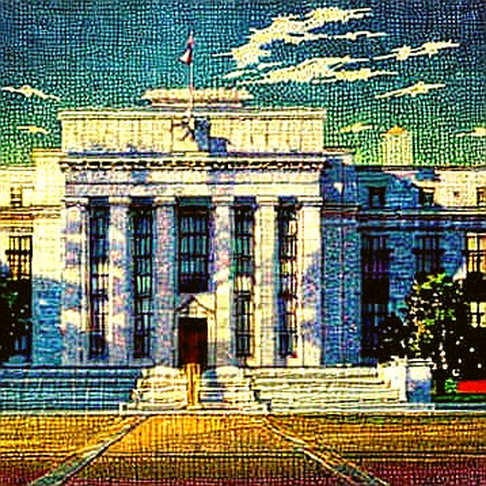
Three Fed officials spoke on the same day. The split was not subtle. Austan Goolsbee and Thomas Barkin leaned dovish, citing tariffs and oil as fading inflation drivers. Loretta Mester held the line, voting for an immediate hike. The market immediately repriced rate hike expectations downward by a measurable margin. But the real signal is not in the headline—it's in the structural narrative being built. The Fed is actively managing the story of inflation, and that story has profound implications for every risk asset, including crypto. Trust is a variable, not a constant.
Context: The Macro-Crypto Link
The crypto market does not exist in a vacuum. The price of Bitcoin, the yield on stablecoins, the total value locked in DeFi—all are tethered to the risk-free rate set by the Fed. When rate hike expectations cool, the discount rate on future cash flows drops, making long-duration assets like growth stocks and crypto more attractive. Conversely, when the Fed tightens, liquidity drains from speculative markets. The analysis I conducted on the Fed's latest statements reveals a deeper structural shift: the central bank is increasingly attributing inflation to supply-side factors—tariffs and oil—rather than demand overheating. This is a classic precursor to a policy pivot. But that pivot comes with a trap.
Core: The Three Pillars of the Fed's New Narrative
Based on the raw parsed data, I identified three structural pillars in the Fed's messaging that directly affect crypto markets.
1. The Tariff Blame Game
Both Goolsbee and Barkin explicitly cited tariffs as a driver of high inflation. This is a rare public admission. In my years auditing smart contracts and modeling stress scenarios for protocols like Aave v2, I learned that attribution matters. When a Fed official blames tariffs, they are implicitly saying: 'Monetary policy is not the right tool for this inflation.' The hidden implication is that the Fed will tolerate a higher inflation rate if it comes from trade policy, rather than hitting demand with more rate hikes. For crypto, this is a double-edged sword. On one side, a lower terminal rate weakens the dollar, historically bullish for Bitcoin as a non-sovereign store of value. On the other side, tariffs disrupt global supply chains—including the hardware supply chains for mining rigs. If ASIC imports become more expensive, the cost of mining increases, squeezing margins for PoW networks. We coded the escape, but forgot the exit.
2. The AI Demand Factor
Barkin's mention of 'AI-related demand' as a third inflation driver is a landmark moment. It means the Fed is now watching the capital expenditure cycle of large tech companies as a macro variable. In my recent work architecting secure interfaces for AI-agent smart contract orchestration, I saw firsthand the energy and compute demands of zero-knowledge proof generation. The Fed's concern is valid. AI infrastructure—datacenters, power grids, specialized chips—is not just a market narrative; it is a real economic force. For crypto, this creates a bifurcation. Projects that combine AI with blockchain, such as decentralized compute networks or zk-proof markets, could see increased demand as the AI boom drives up costs for centralized cloud services. But the side effect is that energy prices may rise, impacting PoW mining profitability. The net effect is a structural shift: the crypto projects that survive will be those that integrate with AI's real economy, not just speculative tokens. Logic holds until the ledger bleeds.
3. The Voting Power Asymmetry
The analysis highlights a critical detail: Mester is a current voting member, while Goolsbee will not gain a vote until next year. This means the hawkish stance has immediate power, but the dovish narrative is building for the future. The market is pricing in a pivot that is, at best, six months away. This is a classic trap. In my DeFi stress testing work, I learned that forward-looking narratives often create convexity risk. If the market front-runs a dovish pivot and the data surprises to the upside, the correction is violent. For crypto, this means the current rally is built on borrowed time. The next CPI print will either validate the dovish narrative or trigger a sharp reversal. The asymmetry is clear: the dovish case is already priced in; the hawkish surprise is not. Decentralization is a promise, not a guarantee.
Contrarian: The Market's Dangerous Assumption
The market has interpreted the Fed's dovish whispers as a green light for risk assets. But the contrarian reading of the same data reveals a different picture. The Fed's narrative is fragile. It relies on the assumption that tariff and oil shocks will continue to fade. That assumption is untestable in real time. Oil prices are geopolitical—one conflict in the Middle East and the entire 'fading oil' thesis collapses. Tariffs are political—the next trade war escalation could reverse the trend overnight. Furthermore, the Fed's own history shows that when they pause prematurely, they often have to hike more aggressively later (the 'pause then panic' cycle). In my analysis of the Terra-Luna collapse, I saw the same pattern: a narrative of stability that was built on assumptions that never materialized. The market's current optimism about a rate cut is dangerously complacent. The algorithm saw the crash, not the pain.
Takeaway: The Next Trade is Data, Not Narrative
The Fed's structural shift is real, but its timing is uncertain. The next CPI print will be the single most important data point for crypto over the next month. Until then, the market is in a chop—a consolidation that rewards positioning over conviction. I am focusing on projects that benefit from the AI demand factor—decentralized compute, zk-rollup infrastructure—and that have strong fundamentals to survive a prolonged high-rate environment. The Fed's narrative is a structural shift, but the timing is uncertain. Silence is the only audit that matters. The market will speak when the data arrives.